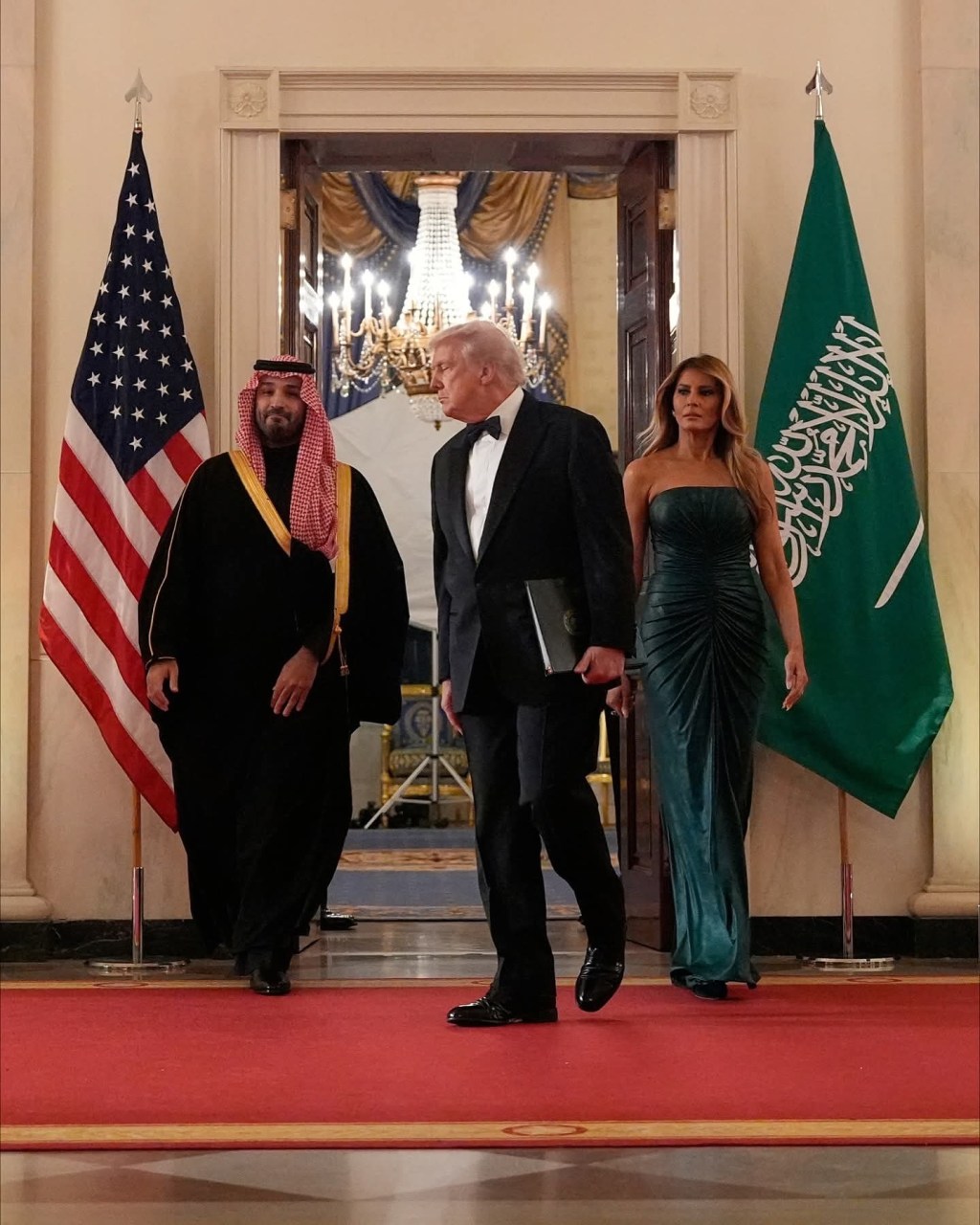
Diplomatic events have always created a mix of politics, symbolism, and aesthetics. But sometimes, the clothes spark more conversation than the policy.
That’s exactly what happened when Melania Trump appeared in a sleek evening gown during the recent visit of a prominent Saudi leader to the United States.
Many people asked:
“Why is her dress being criticized?”
And honestly, the answer is deeper than a single outfit. It’s tied to decades of culture, expectations, and history.
Let’s break it down clearly.
1. It’s Mostly About Cultural Sensitivity
Whenever a Western first lady or female dignitary appears next to a high-profile Saudi or Arab leader, people instinctively expect a certain level of modest dressing. This expectation isn’t based on Saudi law or religious protocol — it’s based on traditional norms.
Saudi culture emphasizes:
Covered shoulders Minimal skin exposure Formal, understated elegance
So, when someone stands next to an Arab leader in a strapless or form-fitting gown, people who hold traditional values naturally feel it clashes with the moment.
It’s less about rules, more about vibes and cultural respect.
2. Many Believe There “Used to Be” a Rule
Historically, hijab has never been required for visiting foreign women — not even for first ladies or heads of state. However, over the decades, many first ladies showed up in:
Long-sleeved gowns High necklines Conservative silhouettes
Because previous visitors voluntarily dressed modestly, people now assume it was a protocol.
So when someone departs from that pattern, it becomes a talking point.
This isn’t about religion — it’s nostalgia for older diplomatic norms.
3. Social Media Intensifies the Reaction
In the age of Twitter, Instagram, and TikTok, a single photo can turn into a global debate.
Everyone becomes:
A fashion critic
A cultural expert
A moral commentator
What might have been a quiet discussion 20 years ago becomes a viral controversy today.
4. There’s Also a New Interpretation: The Modern Protocol Shift
Some argue that Saudi Arabia itself is evolving rapidly. In the last decade:
Dress expectations have relaxed significantly Female attire discussions have softened The kingdom is projecting a more global, modern image
According to this view, the dress wasn’t a mistake — it was simply normal for 2025. But people who prefer the older, more traditional approach don’t feel comfortable with this shift.
5. It’s About Optics — Not Religious Let’s break it down clearly.Rules
The biggest misunderstanding is that people think a foreign woman must wear hijab or specific modest clothing in front of Saudi leaders.
That has never been the case.
The criticism arises because the outfit creates a strong visual contrast — a Western evening gown beside a leader associated with a conservative, historically modest culture.
No law was broken.
No protocol was violated.
But the optics triggered a culture clash, and that’s where the criticism comes from.
Looking Back: How Diplomacy Handled Clothing in Ancient Muslim History
To understand how we reached this point, it’s helpful to look at the early history of Muslim diplomatic missions. Muslim envoys met the superpowers of their eras — Byzantines, Persians, and Chinese courts — and each time, clothing played a symbolic role.
Early Muslims Visiting Byzantium
Muslim envoys wore their own Arab attire: turbans, long robes, sashes.
The Byzantines, despite their love for luxury and gold-threaded garments, respected this. They never required Muslim envoys to adopt local clothing.
Envoys to Persian Kings (Sassanid Empire)
Muslim ambassadors intentionally dressed simply — clean robes, modest presentation — which actually impressed the Persian court with its humility and confidence.
Muslims at Chinese Courts (Tang Dynasty)
Chinese records describe Arab dignitaries in long robes and turbans, and they were admired for their distinct look. The Chinese court did not force foreign guests to adopt Chinese ceremonial dress.
Muslims Visiting European Kingdoms
European courts often admired the flowing robes of Muslim envoys. Clothing wasn’t seen as something to control — it was a symbol of identity.
The takeaway:
Ancient Muslim diplomacy never forced foreign guests into religious clothing, and other empires didn’t force Muslims to change either.
Each side respected the other’s cultural identity.
Conclusion: Why the Debate Keeps Coming Back
The discussion around Melania Trump’s dress isn’t really about fabric — it’s about symbolism.
Some expect traditional modesty in front of Arab royalty. Others embrace the modern diplomatic shift. Social media magnifies the contrast. History shows that clothing has always been a soft-power signal in diplomacy.
At the end of the day, no protocol was broken.
But the visual contrast between a bold Western gown and a conservative cultural backdrop sparked a global conversation — one that reflects our evolving world, generational values, and the delicate balance between modernity and tradition.
 2 Minute Worlds
Leave a comment