Conquest of Syria -Part 2
The arrival of Yemeni tribes in Islamic history isn’t just a date on a cracked manuscript — it is the kind of moment where you feel the sky tilt a little, as if history itself is leaning closer to watch. Days were passing, quiet and grainy, while the first Caliph waited like a man who has sent a message out into the world and is bracing for whatever comes walking back with it.
Then Anas returned from Yemen — dust still tagging along on his clothes like a clingy travel companion. He walked straight to Abu Bakr and, after the warmth of greeting, delivered good news with the breathlessness of someone who knows he’s carrying something precious.
“The people of Yemen,” he said, “have accepted your call with their whole hearts. They’re already marching this way — not reluctantly, not hesitantly, but with a kind of fierce, eager obedience. Every man I met responded as if he had been waiting his whole life for this moment. Their chiefs are coming too, with their families, their armor, and their loyalty sharpened like new steel.”
Abu Bakr’s face softened with relief — the sort that arrives after a long night finally remembers it’s supposed to turn into morning.
The next day slipped by uneventfully, but the following sunrise carried a hum on its shoulders. The people of Madinah rushed to inform the Caliph: They’re coming. The horizon is moving.
Abu Bakr mounted with the others and rode out to welcome them.
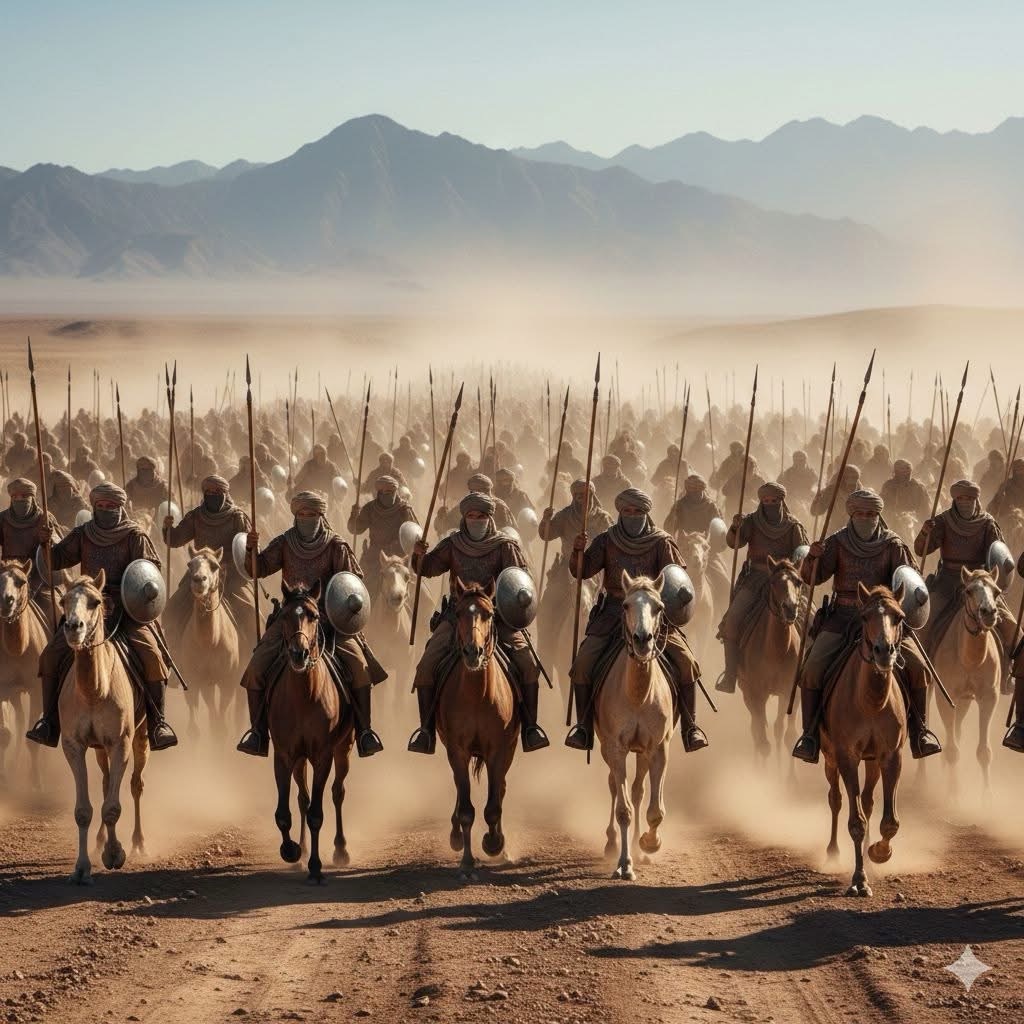
Soon, the air filled with the sound of arriving forces — first a few dust-shapes, then a swelling river of men, banners, armor, and purpose. Regiment stacking behind regiment. Tribe after tribe unfolding like chapters of a story that has been waiting to be told.
All of them traveling from Yemen.
All of them answering the Caliph’s invitation.
All of them coming for the same reason: to fight in the path of God.
The first to step into view was the tribe of Himyar. They looked like they had brought half of Yemen’s iron with them — polished armor, heavy swords, helmets with their own silent swagger, and bows slung like sleeping animals.
Their chief, Dhū al-Kalāʿ al-Himyari, walked forward and introduced his people. Then he recited lines — bold, sharp, and carrying the rhythm of hooves:
“I am from Himyar.
Those you see with me are warriors
whose lineage walks taller than their shadows.
Bravery is our craft,
and I am their chief, Dhū al-Kalāʿ.
Rome is our battlefield.
Syria is our lodge.
Damascus is ours —
and those who hold it will soon learn this truth.”
The words hung in the air like sparks that didn’t know how to fall.
Abu Bakr turned to Ali, the meaning already rising in his eyes.
“Did you not hear the Messenger say,” he asked,
“that when the tribe of Himyar arrives with its families,
tell the Muslims that victory is near?”
Ali nodded. “I heard it exactly like that.”
And in that moment — before swords, before marches, before the dust of Syria would mix with their footsteps — prophecy felt closer than breath.
To be continued…
 2 Minute Worlds
Leave a comment