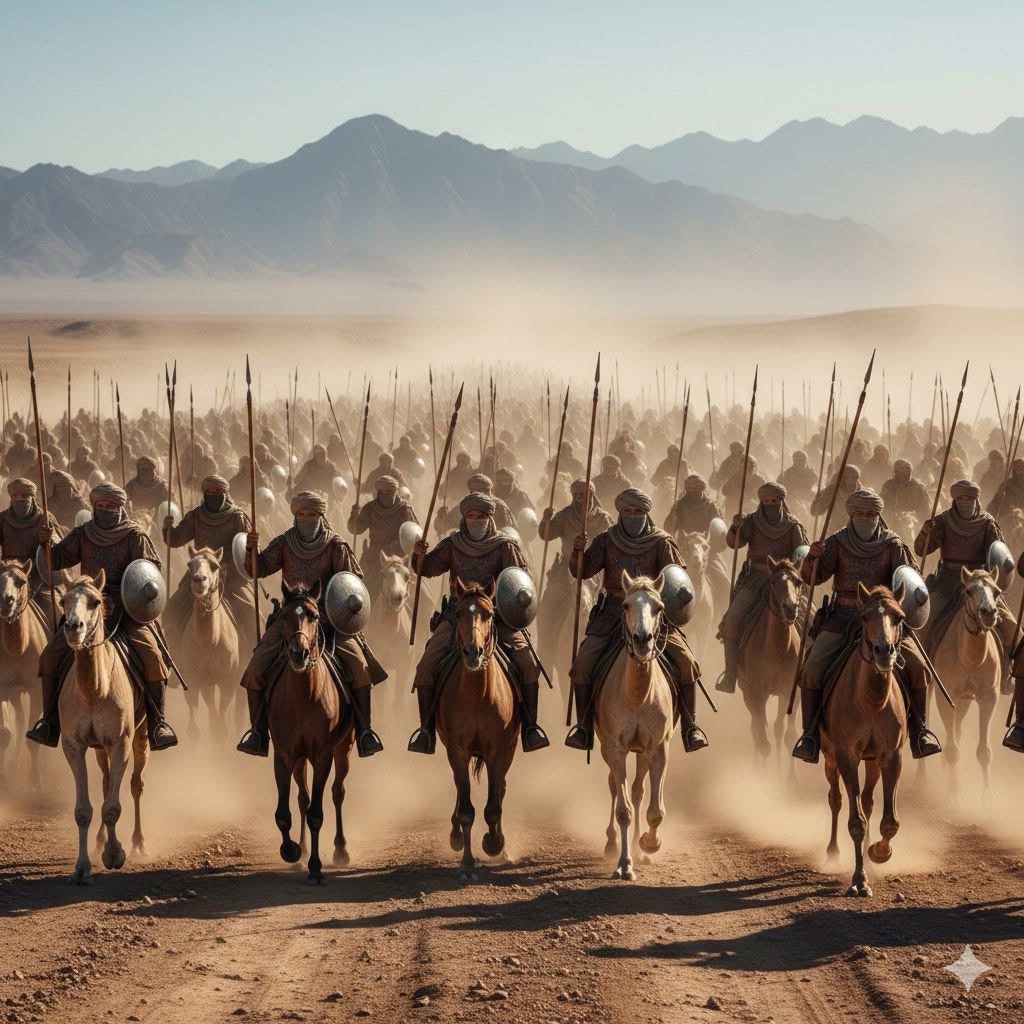
Early Islamic Conquests didn’t begin with swords in the air—they began with a room full of people learning how to breathe again after the Prophet ﷺ left the world. In Madinah, where shadows still remembered his footsteps, Abu Bakr (RA) stood steady on the seat of leadership. Musaylimah was gone, Tulaiha had fled toward the northern winds, Yamamah had been reclaimed, and tribes across Arabia had finally found rhythm in obedience again. Yet beneath all that order, something restless tapped at the horizon: the Campaign of Syria.

One day, Abu Bakr (RA) gathered the Companions. They sat close, their clothes dusty from travel, their hearts pulled tight with memories. He spoke gently, as if picking up a thread the Prophet ﷺ had dropped only a moment earlier.
He reminded them of the divine gift—the faith that shaped them, the victories they hadn’t earned but received, the verse that sealed an entire religion like a completed tapestry:
“Today I have completed your religion for you, perfected My favor upon you, and chosen Islam as your way.” (Al-Māidah)
He reminded them that the Prophet ﷺ had intended to move toward Syria, that he had pointed the compass even if he didn’t get to take the journey himself. And then Abu Bakr (RA) said the quiet part out loud:
he intended to finish what the Prophet ﷺ wanted to begin.
He repeated the prophecy whispered to him:
“The earth was shown to me—its east and its west—and the reach of my Ummah will extend over what I was shown.”
When he asked for their counsel, the room didn’t hesitate—not even for a blink.
“O successor of the Messenger! Command us. Wherever you send us, we go.”
That moment wasn’t just unity; it was a country finding its heartbeat again.
Filled with resolve, Abu Bakr (RA) wrote letters—same ink, same warnings, same hope—to the chiefs of Yemen, leaders of Makkah, and nobles across Arabia. Each letter invited the reader to step into history:
Prepare yourselves. We march to Syria to free it from foreign grasp.
And he sealed those letters with the verse of motion:
“March forth—light or heavy—and strive with your wealth and your lives in the path of Allah…” (At-Tawbah 41)
Then he handed them to Anas bin Malik (RA), the loyal keeper of small moments from the Prophet’s ﷺ life—now entrusted with carrying the beginnings of a new chapter.
And Abu Bakr (RA) waited.
Waited to hear what the tribes would say.
Waited to see which direction history would tilt.
This was how Futuh al-Sham began—not with a battle cry, but with a letter, a prophecy, and a man who believed the future could still expand.
(To be continued…)
Sources & Authenticity:
Futūh al-Shām by al-Waqidi
 2 Minute Worlds
Leave a comment