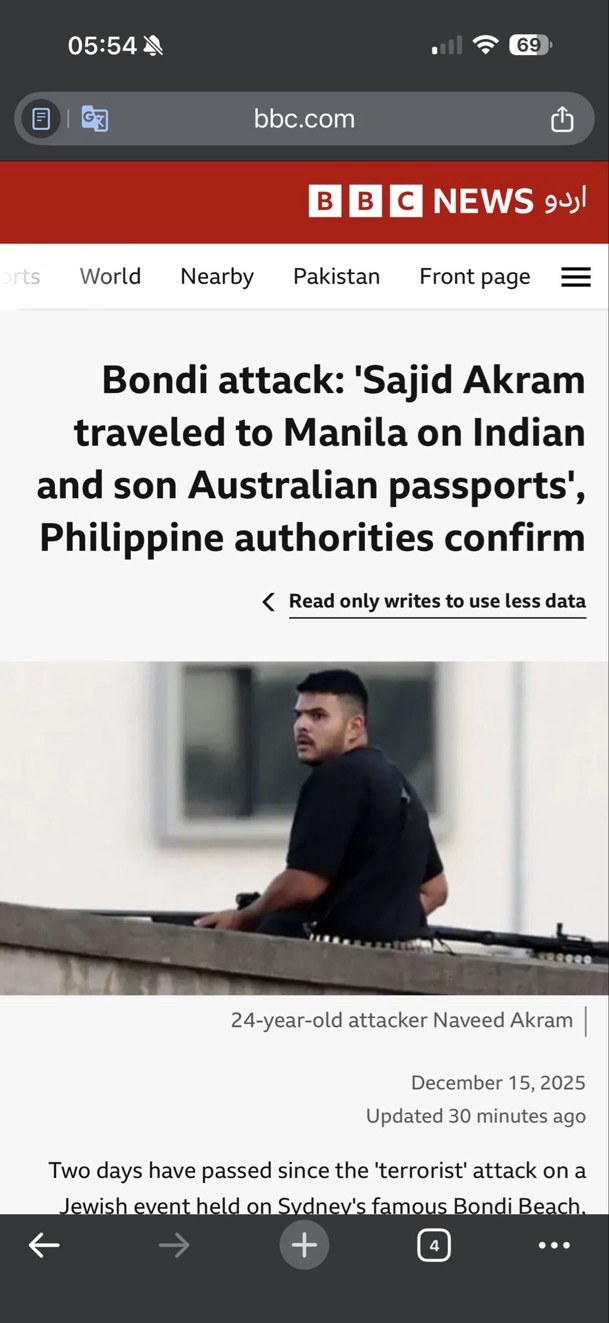
The Bondi Beach shooting investigation keeps changing faces, passports, and backstories. When facts refuse to sit still, curiosity turns into suspicion—and reality begins to feel edited.
Bondi Beach Shooting and the Art of Confusion
The Bondi Beach shooting investigation did not unfold. It morphed.
First, the shooter was Pakistani. Then Indian. Then trained in the Philippines. Then suddenly holding an Indian passport. Later, whispers appeared about prior service with the IDF in Gaza, casually dropped into the narrative like a plot twist no one asked for.
At this point, the event stopped feeling like news and started behaving like a poorly supervised stage play—actors swapping costumes mid-scene while the audience is told nothing has changed.
This is not how clarity looks. This is how confusion performs.
Passports That Change Like Moods
A person usually has one nationality. Sometimes two. Rarely four in one week.
Yet the Bondi Beach shooter’s identity kept rearranging itself as if it were embarrassed by yesterday’s headline. Each update arrived not with evidence but with confidence—the kind of confidence usually reserved for weather forecasts and motivational quotes.
When facts keep changing, the public doesn’t become radicalized. It becomes alert.
And alert citizens are inconvenient.
The Man Who Healed Faster Than the News Cycle
Then came the image.
A man with a severe head injury. Blood. Bandages. Panic. The image went viral, because trauma always does.
Days later, the same man appeared—clean, intact, unbothered. No bandage. No wound. No scar. As if the injury had been a temporary costume rented for the weekend and returned before Monday.
Maybe medicine is miraculous. Maybe photography lies. Or maybe we are watching props being removed once they’ve served their purpose.
Absurdity doesn’t announce itself. It smiles and calls itself “misreporting.”
When Stories Multiply, Truth Shrinks
Here’s the uncomfortable truth:
Conspiracies are not born in basements. They are born in press briefings.
They grow when timelines wobble. They mature when officials overcorrect. They thrive when silence replaces explanation.
History is full of moments where chaos wasn’t an accident but a strategy. Narratives engineered not to convince—but to exhaust. When people are too tired to ask which version is real, they stop asking altogether.
Confusion is not failure. Confusion is leverage.
False Flags or False Confidence?
No one needs to shout “false flag” for the question to exist. The question arrives naturally when reality behaves unnaturally.
Was this incompetence? Was it bureaucracy choking on its own paperwork? Or was it choreography—carefully disorganized, strategically unclear?
The public doesn’t demand perfection. It demands coherence.
And when coherence never arrives, suspicion does.
Why This Still Matters
Because today it’s Bondi Beach. Tomorrow it’s somewhere else.
And every time the story dissolves into contradictions, trust quietly bleeds out—not in dramatic protests or loud revolutions, but in a slow, invisible withdrawal.
That is the most dangerous outcome of all.
Not anger. Apathy.
Final Thought
If truth is solid, it doesn’t need constant revision. If justice is real, it doesn’t change passports.
And if nothing strange is happening, then nothing should feel this strange.
Yet here we are—watching reality edit itself, hoping no one notices the jump cuts.
 2 Minute Worlds
Leave a comment