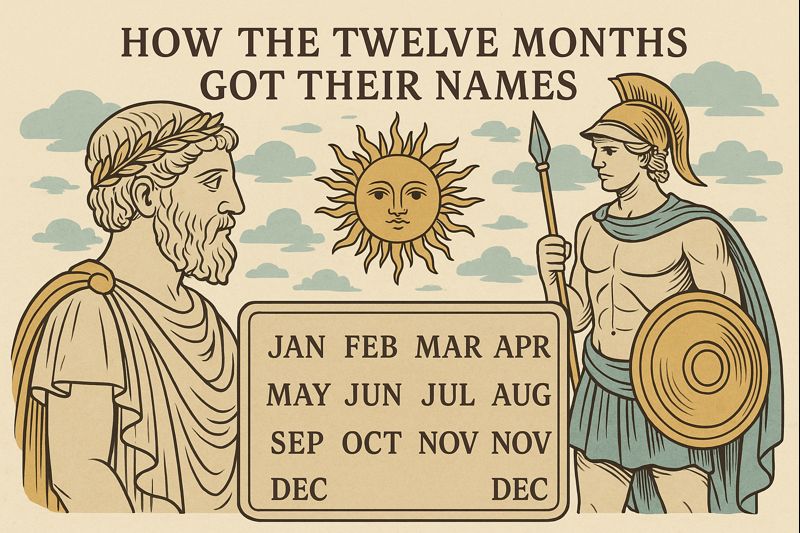
When people ask how the months got their names, they usually expect a boring museum tour. But history has its own sense of humor — like a gatekeeper who keeps dropping hints that time itself is stitched together from old myths, political egos, and the occasional cosmic accident.
We live inside this twelve-room house called a year, pretending it’s all neat and sensible, while its foundations were poured by Romans who believed every thunderclap had an opinion.
Below is a walk through those twelve rooms — each with its own odd story.
January — The Doorway Month
The year begins with a god who never blinked. Janus — an ancient Roman deity with two faces looking in opposite directions — inspired the name January. One face inspected the past; the other squinted at the future, like a man double-checking both pockets after losing his keys.
Some say the name came from Janua, meaning “door,” which feels about right. January is that door we step through while dragging hopes, regrets, and half-finished resolutions behind us.
February — The Month That Tried to Be Pure
February used to be the shy kid at the back of the calendar — once the last month of the year. Later, it upgraded to second place but kept the trauma of being overlooked. That’s probably why it has the fewest days.
Its name comes from Februum, which means “purification.” It was less a month and more a cosmic rinse cycle. Every fourth year, February gets a bonus day, like someone tossing an extra token into its pocket out of pity.
March — When War Steps In Wearing Armor
March is named after Mars — the Roman god of war, storms, noise, and bad ideas. Imagine a divine figure riding a chariot pulled by horses that clearly never read the safety manual. That’s March.
It’s the month when winter loosens its teeth and spring tries a soft entry. The Romans treated March like a military parade. We treat it like a weather guessing game.
April — The Opening Act
April comes from Aprilis, which roughly means “to open.” And that makes sense — buds open, days open, skies open, and suddenly the world behaves like it just remembered how to breathe.
This month wasn’t named after a god. Instead, it feels like the calendar’s attempt at optimism.
May — The Soft Echo of Spring
May draws its name either from the Roman goddess Maia — famous in her mythological neighborhood — or from old Latin forms that whisper of growth.
It’s a month that still carries traces of spring’s perfume, like a room someone left only moments ago.
June — The Month of Queens or Tyrants (Depending on Who You Ask)
June might honor the goddess Juno — daughter of Jupiter — known for her power and her insistence on things being done properly.
Or it may be named after a Roman figure, Junius, a man remembered less for kindness and more for the opposite.
Either way, June is a month that walks in with authority.
July — A Month Named After a Man Who Refused to Be Forgotten
July is the only month that feels like it was named by someone banging a table. Julius Caesar claimed it, and history nodded along.
It used to be the fifth month, but after adjustments, it became the seventh — though it kept the name, like a trophy mounted on a wall.
August — When Power Becomes a Season
August honors Emperor Augustus, who earned the title after being showered with public love (and possibly fear).
Originally shorter, the month borrowed extra days because no emperor wants his month smaller than Julius Caesar’s.
Before calendar reforms, August was the sixth month — until January and February arrived like surprise guests and shifted the furniture.
September — The Month That Forgot Its Own Math
Septem means “seven,” but September is actually the ninth month now.
It’s like a building that got renovated but kept the wrong floor numbers.
October — The Month That Thinks It’s Eight
Octo means “eight.” October proudly carries the name yet stands tenth in line — a reminder that calendars evolved faster than their labels.
November — The Ninth That Became the Eleventh
Derived from Novem, meaning “nine,” November now lives as the eleventh month.
It’s the calendar equivalent of someone whose job title no longer matches what they actually do.
December — The Tenth That Ended Up Last
From Decem — meaning “ten.”
December wraps up the year despite being named for a number it abandoned long ago.
It’s the grand finale of a very confused numbering system.
A Closing Window into Old Beliefs
The Romans eventually abandoned these gods and their wild narratives, letting them drift into myth.
What’s curious is how countless cultures have left behind their old cosmologies — while some belief systems, infinitely stranger, survive with even greater zeal.
Time changes its wardrobe, but people don’t always follow the memo.
 2 Minute Worlds
Leave a comment