Today, the Battle of Nineveh is remembered — not only as a military encounter, but as a moment where a Qur’anic promise stepped out of revelation and into history.
“The Romans have been defeated
In a nearby land.
But after their defeat, they will soon be victorious
Within a few years.”
(Qur’an, Surah Ar-Rum)
At the time these verses were revealed, they sounded almost unreasonable.
Two empires were exhausting each other in a centuries-long struggle:
the Byzantine Roman Empire and the Sassanian Persian Empire.
Their wars stretched across regions, drained economies, erased cities, and turned entire populations into witnesses of endless defeat.
When Rome Looked Like a Corpse
By the early seventh century, the balance of power had tilted violently in favor of Persia.
Roman armies collapsed.
Provinces vanished.
Cities fell like doors without hinges.
Then came 614 CE.
Jerusalem fell.
Sacred Christian relics were taken away.
The Church of the Holy Sepulchre was desecrated.
Many historians later wrote something close to an obituary:
“Rome was no longer an empire — only a dying nation.”
And yet, in the deserts of Arabia, a different narrative was being spoken aloud.
The Prophet Muhammad ﷺ declared that this defeated empire would rise again — not in centuries, not in myths, but within a few years.
The Quraysh laughed.
Empires do not resurrect.
History, however, had other plans.
The Man Who Refused the Funeral
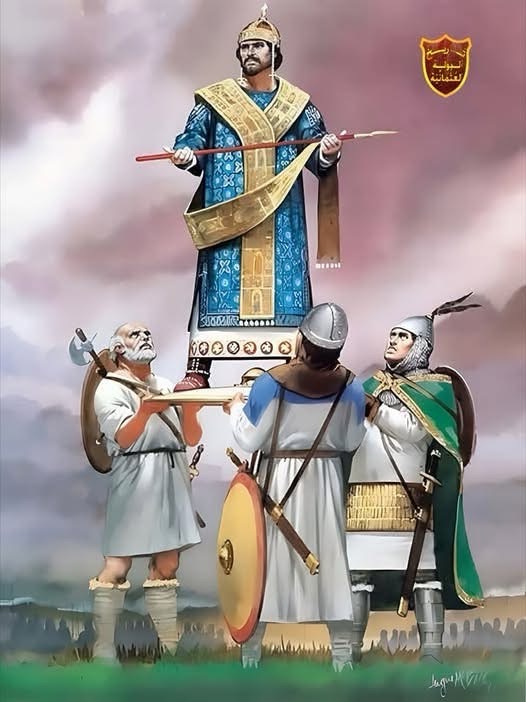
Enter Heraclius.
He took the Byzantine throne in 610 CE, inheriting something barely recognizable as a state.
The treasury was empty.
The army was tired.
The map was shrinking.
Instead of surrendering to inevitability, Heraclius reorganized everything:
the administration the economy the army alliances with Turkic tribes
Then he made a decision that felt irrational but necessary:
He would take the war into Persian territory.
The Fog of Nineveh
On 12 December 627 CE, near the Greater Zab River in present-day Iraq, the final act unfolded:
The Battle of Nineveh.
Heraclius chose a battlefield wrapped in fog.
Persian cavalry — the pride of their military — lost visibility, formation, confidence.
Chaos crept in quietly.
The Persian commander Rhazadh fell.
The lines broke.
The impossible happened.
Rome won.
With that victory, the world felt a subtle shift — as if something ancient had exhaled.
And somewhere, verses revealed years earlier found their footing in reality.
When Prophecy Meets Proof
The Roman victory at Nineveh wasn’t symbolic.
It was decisive.
Heraclius marched deeper into Persia, entering royal palaces like Dastagird, reclaiming banners once stolen, retrieving prisoners, reversing history page by page.
Meanwhile, Persia imploded from within.
Khosrow II lost control.
Civil war erupted.
His own son, Kavadh II, ended his reign brutally.
Peace followed — not generous, not cruel — simply exhausted.
Rome recovered its lands.
Its prisoners.
Its sacred relics taken from Jerusalem.
Nineveh became the last great battle of the Roman–Persian wars.
A Cross Returns… But Not the World It Knew
Heraclius returned in triumph.
In a deeply symbolic act, he carried the Cross back to Jerusalem.
He believed a new Byzantine age had begun.
History smiled politely — and moved on.
Because just a few years later, men emerged from Arabia carrying a message, not an empire.
The Sassanian Empire vanished forever.
Syria and Egypt entered Islamic rule.
The world crossed into a new historical chapter.
Why Nineveh Still Matters
The Battle of Nineveh was not just about swords and strategies.
It was:
a fulfillment of revelation a reminder that power collapses quietly a hinge between civilizations
A moment where divine promise and human history shook hands — briefly, decisively.
And then walked in different directions.
References
Al-Ya‘qubi — Tarikh al-Ya‘qubi Al-Tabari — Tarikh al-Umam wa al-Muluk Walter Kaegi — Heraclius: Emperor of Byzantium
 2 Minute Worlds
Leave a comment