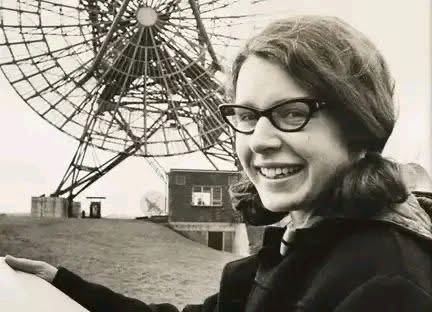
At 24, She Changed the Universe — The Nobel Went Elsewhere, Her Answer Became History
At 24, She Changed the Universe — The Nobel Went Elsewhere, Her Answer Became History
Keywords: Jocelyn Bell Burnell, pulsar discovery, women in science, Nobel Prize controversy, astronomy history
She was only twenty-four when she noticed it.
A thin, stubborn line on a long paper chart — the kind most people would ignore, the kind history quietly waits for.
In 1967, Jocelyn Bell Burnell was a PhD student at Cambridge University. Her task was considered academic drudgery: day after day, scanning endless radio-telescope printouts filled mostly with noise. Static. Scribbles pretending to be data.
This is where discoveries usually die — between boredom and impatience.
Then one November night, something refused to behave.
A signal — precise, disciplined — repeating every 1.3373 seconds. Not once. Not twice. Always.
Machines fail randomly.
Earth is messy.
But the universe, when it speaks clearly, repeats itself.
She checked again. And again. The signal appeared at the same point in the sky each night, moving with the stars. Someone jokingly labeled it “Little Green Men.” Jocelyn ignored the joke and kept listening.
Soon there were more signals. Four in total.
This wasn’t alien life.
It was something stranger — and more beautiful.
Pulsars: Dead Stars That Keep Perfect Time
What she had discovered were pulsars: rapidly spinning neutron stars, the collapsed remains of massive suns that died in violent supernovae.
Objects so dense a spoonful would outweigh a mountain.
So precise they rival atomic clocks.
Their discovery confirmed theories about how stars die and opened entirely new doors in astrophysics — from black holes to gravitational waves. Modern astronomy still leans on that quiet moment when a young student chose patience over dismissal.
The Nobel That Looked the Other Way
In 1974, the Nobel Prize in Physics was awarded for the discovery of pulsars.
Jocelyn Bell Burnell did not receive it.
The prize went to her supervisor and the engineer who built the telescope. The omission sparked outrage. Senior scientists called it unfair. The moment became a case study in how women’s contributions were often quietly edited out of recognition.
Jocelyn did something unexpected.
She refused to let bitterness become her biography.
What She Did Instead of Being Angry
She became one of the world’s most respected astrophysicists.
She taught. She mentored. She led institutions. She spoke calmly about science and firmly about fairness.
Then, fifty years later, recognition returned — quietly.
In 2018, she received a major international science award worth $3 million.
She accepted it.
And then gave every dollar away.
Scholarships — for women.
For ethnic minorities.
For refugee students.
For people who, like her once, stood outside rooms that pretended not to hear them knocking.
Her explanation was disarmingly simple:
“I don’t need the money. Creating opportunities matters more.”
A Long View of History
History has always been like this.
Around 3000 BCE, Babylonian astronomers mapped the skies anonymously so others could navigate by them.
In ancient Alexandria, Hypatia taught mathematics without titles — and paid for knowledge with her life.
Galileo was punished not for being wrong, but for being early.
Different centuries. Same lesson.
Truth survives people.
Ego does not.
Why This Story Matters
Science isn’t just about discovering the universe.
It’s about deciding who gets to discover it next.
Her research still helps us understand the cosmos.
Her generosity decides who gets access to the telescope.
Awards fade.
Access multiplies.
A Gentle Way Forward
The Qur’an reminds us:
“And whoever does an atom’s weight of good will see it.” (Qur’an 99:7)
And the Prophet Muhammad ﷺ said:
“The best of people are those who are most beneficial to others.”
She lived both — without sermon, without spectacle.
Final Thought
An award was taken from her.
She answered with dignity, patience, and a legacy no medal can compete with.
Recognition disappears into footnotes.
But lifting others rewrites the future.
And history, eventually, notices.
 2 Minute Worlds
Leave a comment