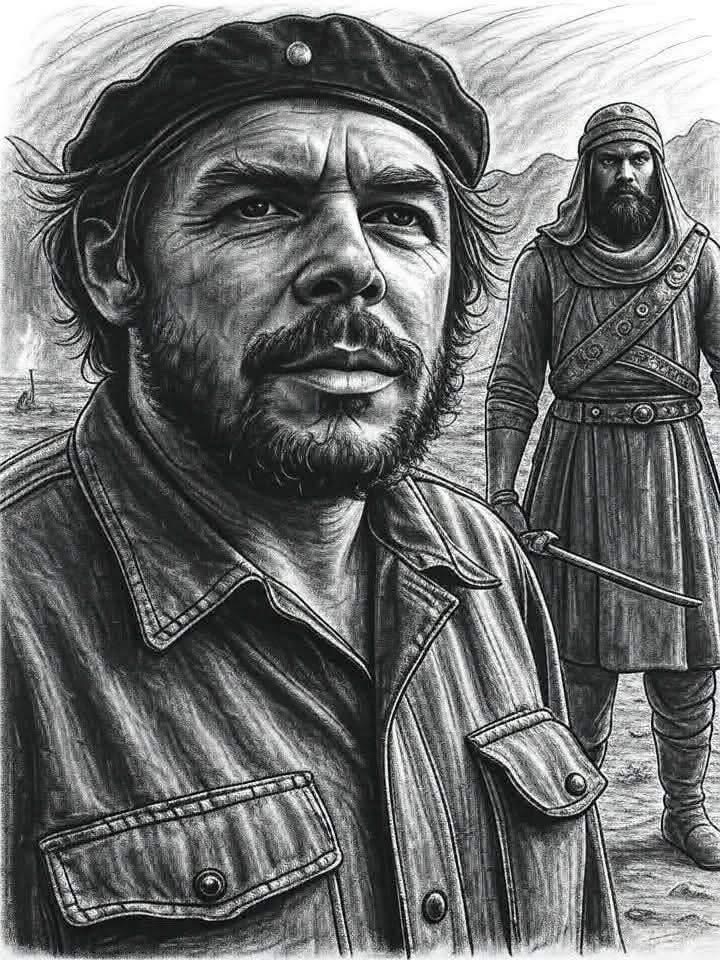
When Revolutions Scare Goats: Che Guevara, Napoleon, and the Price of Fighting for People
When Revolutions Scare Goats: Che Guevara, Napoleon, and the Price of Fighting for People
Excerpt: History keeps repeating a strange joke: revolutions are loud, ideals are noble, and ordinary people often just want their goats to stay calm. From Che Guevara’s betrayal to Muhammad Karim’s lonely stand against Napoleon, this is a story about courage, cowardice, and why heroes so often die alone.
When Revolutions Scare Goats
When Che Guevara was finally captured in Bolivia, the world learned that his hideout had been revealed by a shepherd. Someone later asked the shepherd, almost offended on behalf of history:
“How could you sell out a man who spent his life fighting for your rights?”
The shepherd answered with the calm cruelty of survival:
“His war with the enemy was frightening my goats.”
That single sentence explains more about failed revolutions than entire libraries. Che Guevara did not fall because of lack of courage. He fell because courage is loud, and ordinary life prefers silence.
Alexandria, 1798: A Hero Walks Alone
Years earlier, Egypt witnessed the same tragedy wearing different clothes.
When Napoleon Bonaparte invaded Egypt in 1798, Alexandria resisted under its governor Muhammad Karim. He fought. He lost. He was captured. Then history paused for a theatrical conversation.
Napoleon told him:
“I regret killing a man who defended his homeland so bravely. I do not wish to be remembered as someone who executes patriots. Pay ten thousand gold coins as compensation for our dead soldiers, and you will be spared.”
Muhammad Karim smiled.
“I don’t have that much,” he said. “But the merchants owe me more than one hundred thousand gold coins.”
Napoleon granted him time.
Still in chains, surrounded by occupying soldiers, Muhammad Karim walked through Alexandria’s markets. These were the people he had defended. Not one merchant paid. Instead, they blamed him for ruining trade and destroying the city.
When he returned empty-handed, Napoleon concluded:
“I am not killing you because you fought us. I am killing you because you sacrificed yourself for cowards—people for whom commerce is more valuable than freedom.”
Muhammad Karim was executed soon after.
The Old Diagnosis of a Sick Society
Decades later, Islamic reformer Muhammad Rashid Rida summarized this tragedy with surgical precision:
“Bringing revolution to an ignorant nation is like setting yourself on fire to light the path for a blind man.”
A Pattern Older Than Empires
From ancient rebellions crushed in early civilizations (5000 BCE) to Spartacus in Rome, to Che Guevara in Bolivia, history repeats one truth:
People love justice—as long as it does not disturb their comfort.
Revolutions fail not because enemies are powerful, but because supporters are exhausted.
Why It Still Matters
Every generation waits for a hero. Every hero waits for a nation. And often, the nation is busy counting coins.
This is not an argument against resistance. It is a warning: without awareness, sacrifice turns into tragedy.
A Way Forward
The Qur’an quietly explains the rule history keeps enforcing:
“Indeed, Allah does not change the condition of a people until they change what is within themselves.” (Qur’an 13:11)
And the Prophet Muhammad ﷺ said:
“The strong believer is better and more beloved to Allah than the weak believer.” (Sahih Muslim)
Strength begins with awareness, not slogans.
Sources
- Jon Lee Anderson, Che Guevara: A Revolutionary Life
- Abd al-Rahman al-Jabarti, Ajāʾib al-Āthār
- Muhammad Rashid Rida, Tafsir al-Manar
 2 Minute Worlds
Leave a comment