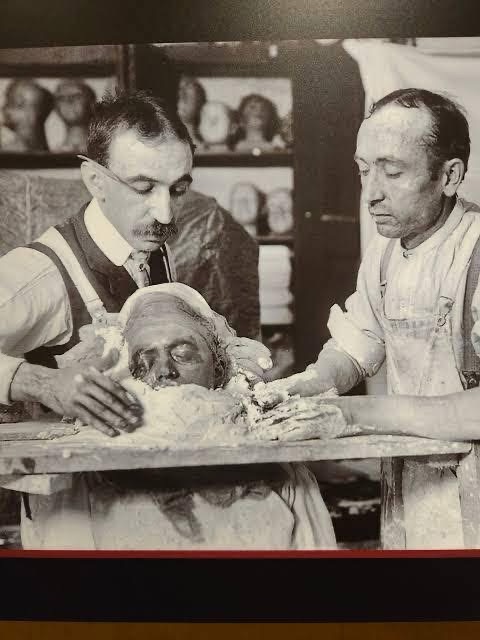
The Face That Stayed After the Body Left
Imagine this: someone dies in your house.
No camera. No painter. Not even a blurry sketch hiding in a drawer.
You want to remember their face—but memory, like ice in warm hands, melts fast.
So you call a specialist.
This is not fiction. About 150 years ago in Europe, especially Paris, this was common practice. According to Encyclopaedia Britannica, families preserved faces using death masks—plaster casts taken directly from the deceased.
The house would fall silent.
Children were moved away. Curtains lowered halfway.
Candles burned softly, as if light itself had learned how to whisper.
People believed loud crying hurt the dead.
So grief learned to breathe quietly.
How a Death Mask Was Made (A Ritual in Four Acts)
The body was laid flat, usually in the drawing room.
The face tilted upward, toward the ceiling—or maybe heaven.
The plaster caster began:
Eyes gently closed Wax applied to eyelashes so they wouldn’t stick Small straws placed in the nostrils to release heat Wet plaster spread from forehead to chin
Thirty minutes if the face cooperated.
Two hours if it resisted—or if the artisan was new.
The hardest part came last: removing the mask.
Skin sometimes peeled.
Expressions collapsed.
Families often stepped outside because love is brave—but not that brave.
Famous Faces That Refused to Die
The death mask of Napoleon Bonaparte remains controversial.
Historians argue the existing version may be fake—another mask wearing a mask.
(Referenced by Napoleon.org)
Then there is L’Inconnue de la Seine—the unknown girl of Paris.
Her mask is calm. Almost smiling.
People said looking at it could either bring great luck…
or quietly ruin your life.
The Financial Times once described her face as “the Mona Lisa of the drowned.”
Death, apparently, has better PR than life.
Not Every Memory Was Innocent
Some European occult societies believed death masks could trap spirits.
Control them.
Question them.
Borrow their silence.
Each culture had its preferences:
Britain honored kings and war heroes Germany preserved philosophers and artists Russia immortalized revolutionaries
Then photography arrived.
And faces learned how to stay without pain.
Why This Still Matters
We think we remember people through images.
But images are lazy. They remember for us.
Death masks forced presence.
You had to stand there. Watch. Wait. Accept.
Even today, we ask the same question in different ways:
How do you keep someone after they’re gone?
A Way Forward (A Gentle Reminder)
The Qur’an reminds us:
“Every soul shall taste death.” (Qur’an 3:185)
And the Prophet ﷺ taught that when a person dies, what remains is not the face—but the trace: good deeds, knowledge, kindness left behind.
Maybe the truest death mask…
is how gently someone altered the lives around them.
 2 Minute Worlds
Leave a comment